Advocacy Priorities



-
SEARAC is a proud co-sponsor of AB 1537 (Bryan), which would prohibit certain law enforcement officers from taking secondary employment with Immigration and Customs Enforcement or other immigration authorities. This does not include service with any branch of the United States Armed Forces.
-
AB 2600 (Bonta) would establish a statutory right to legal counsel for individuals in California facing deportation proceedings, prioritzing those in immigration detention. Legal representation is a critical lifeline that defends due process rights and helps keep California families together and free.
-
AB 1878 (Patel) would standardize precise racial and ethnic data collection across California state agencies to ensure taxpayer dollars are efficiently serving and representing all Californians. This would help our state implement new federal standards (Statistical Policy Directive 15) that include more Southeast Asian groups. More detailed data about our communities can reveal hidden disparities and improve outcomes.
-
SB 1422 (Durazo) would lift the Medi-Cal enrollment freeze for immigrants by restoring full scope Medi-Cal for those ages 19 & older with Unsatisfactory Immigration Status.
-
AB 2161 (Bonta) would help harmful work requirements on state-funded Medi-Cal populations by requiring additional engagement by departments to help Medi-Cal applicants obtain and maintain coverage before requesting more data.
2026

2025
-
SCR-96 (Wahab) commemorates 50 years since Southeast Asian refugees began resettling in the United States, honors their sacrifices, recognizes their contributions, uplifts the principles of second chances, rehabilitation, and intergenerational healing for Southeast Asian Americans who resettled in the United States and California, and resolves the Legislature’s continued pursuit of comprehensive policies for Southeast Asian American communities.
-
AB 1242 (Nguyen) would revise and expand requirements under the state's Dymally-Alatorre Bilingual Services Act and require the California Health and Human Services Agency to designate a Language Access Director. The Dymally-Alatorre Bilingual Services Act ensures that all community members, regardless of what language they speak, receive the support they need from public programs through appropriate language access.
-
SEARAC advocates with state-level coalitions, such as Health4All and Rep4All, around protecting healthcare costs/affordability and legal services.
Health4All is an ongoing effort to remove exclusions to health coverage and ensure all Californians can access care, regardless of their immigration status. Rep4All is campaign to enhance and expand access to legal services and representation for immigrant Californians, regardless of past contact with the criminal legal system.
-
SEARAC successfully advocated for the inclusion of lesson plans on SEAA communities into the CA Ethnic Studies Model Curriculum and supported the development of model curricula centering Cambodian, Hmong, and Vietnamese American histories, culture, and refugee experiences (SB 895). SEARAC continues to ensure meaningful implementation of ethnic studies curricula across CA, as well as to share and build resources and curricula centering SEAA communities.
-
SEARAC and members of the SEAA Collaborative championed AB 1726, which requires California public health data to be disaggregated by AANHPI subgroups and reflect the incredible diversity of our communities. Disaggregated data exposes the unique health needs of SEAAs and gives community leaders the specific insights they need to create more effective public health strategies. Today, we engage state and local officials to ensure access to this critical data and full implementation of this legislation.
-
In order to implement AB 1726, a landmark legislative win requiring state public health data to be disaggregated by a fuller set of AA & NHPI subgroups, SEARAC secured the creation of CA Dept. of Public Health (CDPH) Data Disaggregation Workgroup in 2024. Alongside CDPH, SEARAC co-chairs the workgroup with the Latino Coalition for Healthy California and the UCLA NHPI Data Policy Lab. The workgroup is comprised of over 60 CDPH staff, subject matter experts, academics, healthcare providers, local health jurisdictions, and community-based organizations.
-
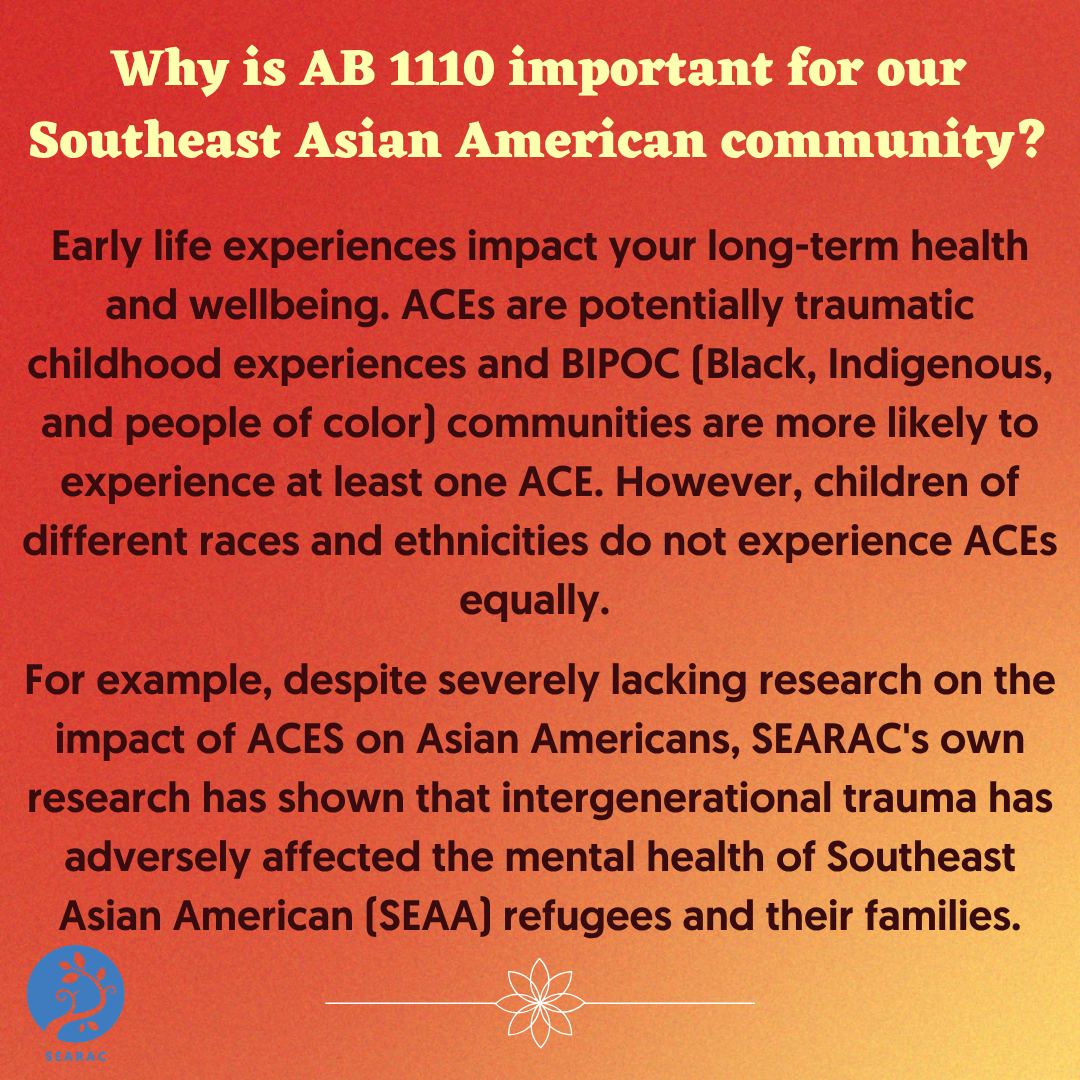
We can address the impacts of ACEs, intergenerational trauma, and toxic stress that youth in SEAA communities may face by supporting bills like AB 1110 (Arambula), which will advance culturally competent ACEs screenings and the disaggregation of ACEs data by race & ethnicity. Learn more about ACEs from our partner ACEs Aware here.
2024